
If you want to dominate Google search results, you need to master keyword research. The right keywords are a foundation that builds a company’s website traffic into a consistent part of a successful marketing strategy. Identifying the right keywords are the foundation of every successful SEO strategy. The truth? You don’t need to be an expert or spend thousands on tools to get started.
In this comprehensive guide, you’ll learn:
✅ How to uncover EXACTLY what your audience is searching for (including geo-targeted, question-based, and buyer-intent keywords)
✅ The best free & paid tools to find high-traffic, low-competition keywords
✅ How to dominate your niche using The Quantum SEO Method (owning every relevant keyword in your space)
✅ Real examples of keyword strategies that drive traffic, leads, and sales
Let’s dive in.

Why Keyword Research is Non-Negotiable
Before you create any content—whether a blog, service page, or product listing—you must know:
- What phrases your audience is typing into Google
- Which keywords your competitors are ranking for
- How to prioritize terms that actually convert
Skipping keyword research means:
❌ Creating content no one searches for
❌ Losing traffic to competitors who do their research
❌ Wasting time and money on guesswork SEO
❌Guessing what the market is interested in instead giving the value that the
The Benefits of Smart Keyword Research:
🔍 Uncover hidden opportunities (low-competition, high-intent keywords)
📈 Drive consistent organic traffic (no ads needed)
💰 Attract ready-to-buy customers (high conversion rates)
Step 1: Start With Seed Keywords (Even Just 1 Word Works!)
Seed keywords are your starting point—the basic terms related to your business. These can be:
- Single words (e.g., “dentist”)
- Phrases (e.g., “emergency plumber”)
- Questions (e.g., “how to fix a leaky faucet”)
Examples of Seed Keywords:
- “Dentist” (Broad seed keyword)
- “Medicaid dentist” (Niche-focused)
- “Best dentist in Miami” (Geo + “best” modifier)
- “How much do dental implants cost?” (Question-based)
Pro Tip: Start with broad terms, then expand into long-tail variations (more on this later).
Step 2: Use These Powerful Keyword Tools (Expanded!)
Now, let’s expand your seed keywords using tools that reveal thousands of search variations.
1. 🔎 SpyFu (Competitor Keyword Spy Tool)
– Best for: Finding every keyword your competitors rank for
– Game-Changing Feature: Enter just 1 seed keyword (e.g., “dentist”), and SpyFu shows you:
- All related keywords (e.g., “Medicaid dentist near me,” “pediatric dentist,” “cosmetic dentist NYC”)
- Search volume & difficulty
- Competitor ads (see what’s working for others)
- There is also a search
Example: “Dentist” in SpyFu Reveals Thousands of Variations
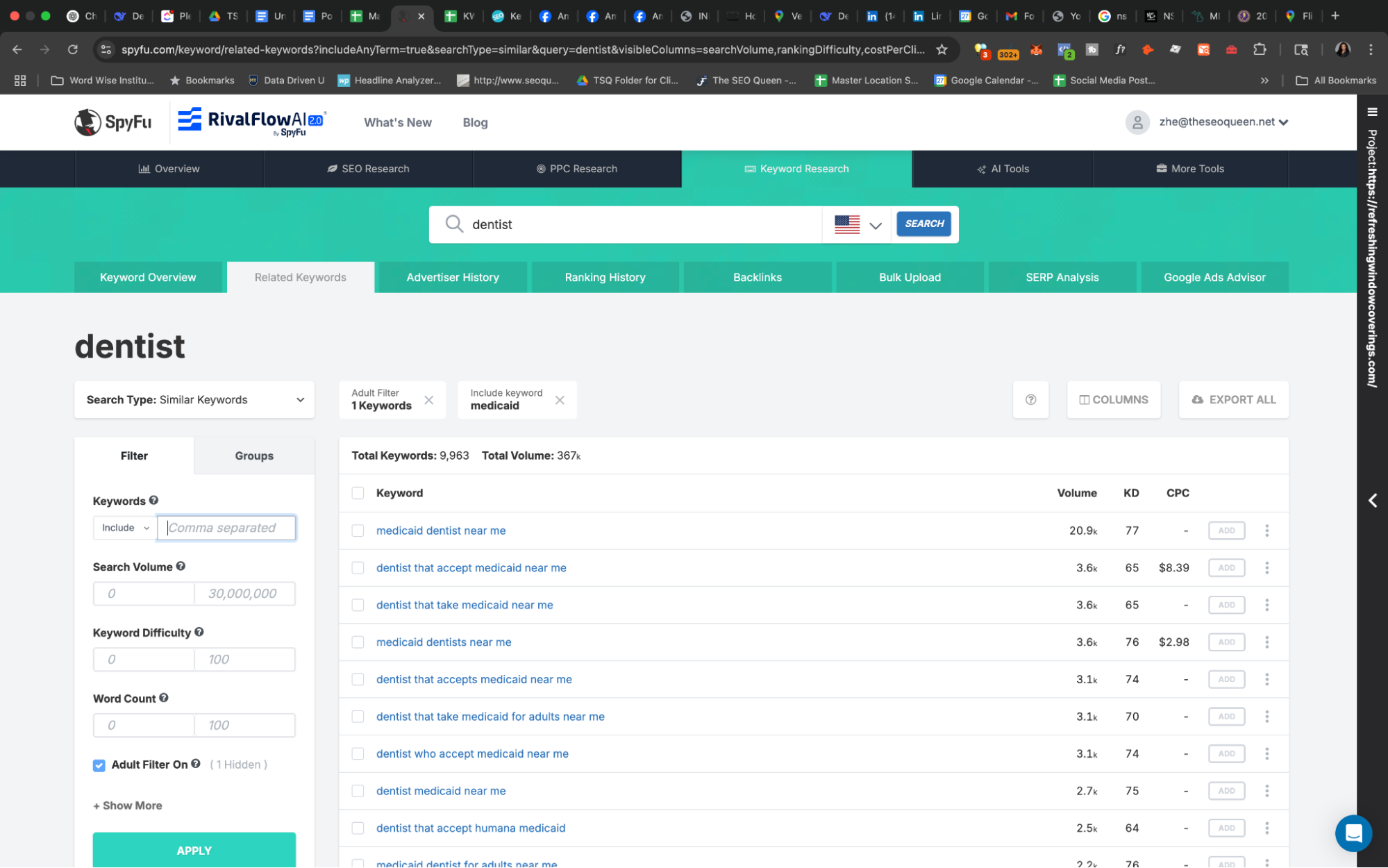
(SpyFu Screenshot showing keyword variations like “Medicaid dentist near me,” “emergency dentist open now,” etc.)
Why This Matters:
- You can own your niche by creating content for every relevant keyword to your products and services
- This is The Quantum SEO Method—treating keywords like an economy to dominate.
2. 🗺️ Google Keyword Planner (Free with Google Ads)
- Best for: Finding search volume & competition levels
- Pro Tip: Use it to find geo-modified keywords (e.g., “dentist Atlanta” vs. “dentist”).
3. 🔮 AnswerThePublic (Free/Paid)
- Best for: Question-based keywords
- Example: Type “dental implants” → Get “are dental implants worth it,” “how long do dental implants last,” etc.
- Having content that answers questions in your unique way sends Google the signal that your business is legit and will award you with more traffic. It is very important to invest in creating content that answers questions.
4. 📌 Google’s “People Also Ask” (Free Goldmine!)
How it works:
- Google a keyword (e.g., “Medicaid dentist”).
- Scroll to “People Also Ask”—these are real user questions you can target.
Step 3: Target These 6 High-Intent Keyword Types
Not all keywords are equal. Focus on these high-converting types:
1. Question Keywords (“How,” “What,” “Why”)
- Example: “How to find a dentist that accepts Medicaid”
- Why? Perfect for blog posts & FAQs, and this is also phenomenal for voice search visibility.
2. Geo-Targeted Keywords (City/State + Service)
- Example: “Emergency dentist Miami”
- Why? Local searches convert 5X higher.
3. “Near Me” Keywords (Hyper-Local Intent)
- Example: “Dentist open Saturday near me”
- Why? Mobile users search this way—optimize for GBP.
4. “Affordable” Keywords (Budget Buyers)
- Example: “Affordable dental implants near me”
- Why? Attracts price-sensitive shoppers.
5. “Best” Keywords (Comparison Shoppers)
- Example: “Best pediatric dentist in Chicago”
- Why? These searchers are ready to choose.
6. “For Sale” Keywords (Buyer Intent)
- Example: “Invisalign for sale Houston”
- Why? These searchers are ready to purchase.
Step 4: The Quantum SEO Method (Dominate Your Niche)
Most businesses only target a few keywords. The Quantum SEO Method flips this:
- Find EVERY relevant keyword (using SpyFu, Google Planner, etc.)
- Group them by intent (informational, commercial, transactional)
- Create content for each cluster (blogs, service pages, FAQs)
- Interlink strategically (build topical authority)
Example: Dentist Using Quantum SEO
| Keyword Cluster | Content Type | Example Keywords |
| Medicaid Dentist | Service Page | “Medicaid dentist near me,” “does Medicaid cover root canals” |
| Pediatric Dentist | Landing Page | “best pediatric dentist Miami,” “kid-friendly dentist” |
| Dental Implants | Blog + Service Page | “cost of dental implants,” “are implants worth it” |
Result: You own the entire keyword economy for your niche.
Step 5: Prioritize Keywords Like a Pro
Use this 3-factor system to choose winning keywords:
✅ Search Volume (100+ monthly searches)
✅ Low-Medium Competition (Easier to rank)
✅ High Intent (Transactional > Commercial > Informational)
Example: “Dentist” vs. “Emergency Dentist Open Now”
| Keyword | Volume | Competition | Intent | Priority |
| “Dentist” | 300,000 | High | Informational | Low |
| “Emergency dentist open now” | 12,000 | Medium | Transactional | High |
Winner: “Emergency dentist open now”—lower competition, ready-to-call customers.
Step 6: Track & Optimize (Keyword Spreadsheet Template)
Organize keywords in a Google Sheet like this:
| Keyword | Volume | KD | Intent | Content Type | Status |
| “Medicaid dentist near me” | 9,900 | 65 | Transactional | Service Page | ✅ Published |
| “How to fix receding gums” | 5,400 | 40 | Informational | Blog Post | ⏳ Writing |
Pro Tip: Update this monthly—SEO is a living strategy.
Final Thoughts: Stop Guessing, Start Dominating
Keyword research isn’t just about finding a few terms, it’s about owning your entire niche. When you go after the long tailed keywords and questions first make sure that they include your one or two word phrase from school. When you create long tailed content you are getting more of your website pages indexed by Google. Once you finish building the pages with the long tailed keywords and you get indexed, and then you ascend to Google Page 1, all of this trust and expertise established on your blog will help to catapult your business to stay consistent and ascend to Google Page 1 With The Quantum SEO Method, you can:
✔️ Discover thousands of untapped keywords (questions, geo-terms, “near me”)
✔️ Create content that dominates search results
✔️ Turn your website into a lead-generating machine
✔️ Destroy the myth that less is more for your website. The reality for a website is that more is more.
Ready to go deeper? Check out our CEO’s Book:
“SEO Training: Search Engine Optimization and Marketing for Small Business.”
💡 Your Turn: What’s the #1 keyword you want to dominate? Comment below! 👇
