

Let me tell you what nobody in the marketing world wants to admit right now.
Everyone is screaming about artificial intelligence. Every podcast, every LinkedIn post, every marketing conference has the same breathless headline: AI is changing everything. Search is dead. Google is irrelevant. Adapt or die.
And here’s what I say to all of that: slow down.
Because while everyone is running around rearranging the furniture, the foundation of the house hasn’t moved one inch. People are still using words. They have always used words. And as long as human beings are the ones doing the searching — whether they’re typing into Google, talking to Siri, or prompting ChatGPT — words are going to matter. Your job as a small business owner is not to panic about the technology. Your job is to make sure you are using the right words.
Let me break this down for you.
AI Didn’t Kill Search. It Changed the Front Door.
Here is something that should both wake you up and focus your strategy at the same time.
Web-scraping tracker Tollbit found that AI bots made up 2 percent of all web traffic in the fourth quarter of 2025 — up from just half a percent at the start of that same year. To put that shift in human terms: in early 2025, there was one AI bot visit for every 200 human visits to a website. By the end of the year, that ratio had narrowed to one AI bot visit for every 31 human visits. And according to a Pew Research survey, 62 percent of U.S. adults are now using AI in some form at least several times a week — with one in three adults under 30 interacting with AI tools at least several times a day. (Chris Morris, Inc., February 9, 2026)
That is a dramatic shift. And it is accelerating.
But here is what I need you to notice — really notice — about those numbers. The humans are still there. The ratio changed. The human did not disappear. People are using AI to search. People are still searching. The front door changed. The person walking through it did not.
The Bot Is Looking for Your Words Too
Now here is where this gets critical for your business strategy — and where most SEO conversations go completely off the rails.
The Inc. report breaks down two types of AI bots currently flooding the web. The first are training bots, which scrape content to help build and improve AI models. The second — and the faster-growing category — are RAG bots. RAG stands for Retrieval-Augmented Generation. These bots retrieve information from the web in real time, combine it with an AI model’s existing knowledge, and generate an answer for the person who asked the question.
In other words: when someone asks ChatGPT a question and receives a detailed answer, a RAG bot likely went out and gathered content from websites to help formulate that response. The quarterly growth rate for RAG bots jumped 33 percent between the second and fourth quarters of 2025 alone — climbing from 3.33 million scrapes to 5.88 million. By year’s end, the average scrapes per page for a RAG bot was roughly ten times that of a training bot. OpenAI’s ChatGPT-User bot was the biggest driver, scraping five times as many pages as the next highest company.
Here is the part that should stop you cold: the clickthrough rate for AI apps — meaning the percentage of users who actually visit a source website after receiving an AI-generated answer — dropped from 0.8 percent in Q2 of 2025 to just 0.27 percent by the end of the year.
So AI bots are scraping your content. And then people are reading the AI’s summary of your content without ever visiting your site.
This is not a reason to give up on SEO. This is a reason to double down on the quality and clarity of your language. Because the AI is reading your words and deciding whether they are worth summarizing for someone who just asked a question. The only way you make that cut is if your content is genuinely answering real questions in clear, specific, authoritative language.
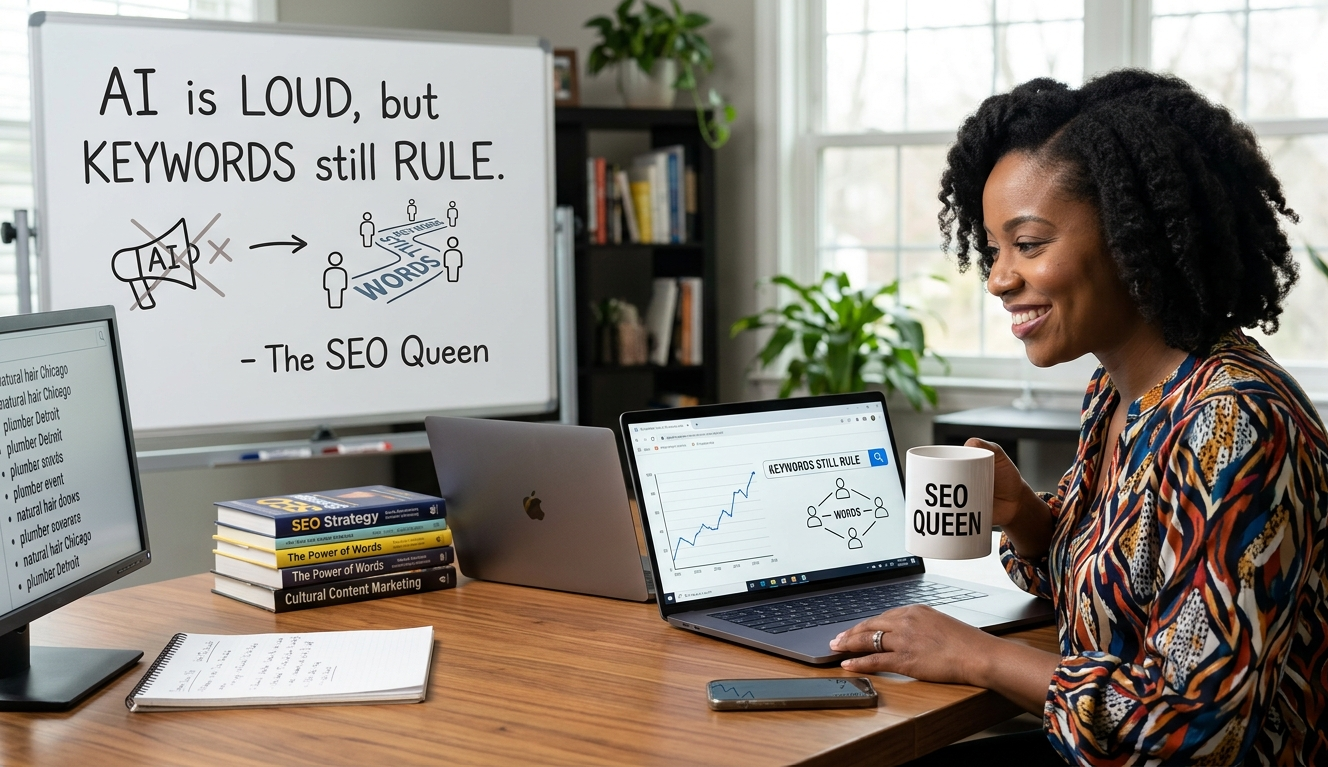
Keywords still rule. They just have a new audience alongside the human one.
The Word Has Always Been the Foundation
Think about what a search actually is.
Someone wakes up on a Tuesday morning. Their back hurts. They don’t know if it’s a muscle strain or something more serious. They pick up their phone — or open their laptop, or ask their smart speaker — and they say something like: “lower back pain after sleeping, what does it mean?”
That is a keyword phrase. It is also a human being in a moment of vulnerability, reaching out for help.
Now replace that person’s back pain with your customer’s problem. Maybe they need a plumber in Detroit. Maybe they’re looking for a Black-owned bakery in Atlanta for a birthday cake. Maybe they’re a small business owner in Flint who needs help with their website’s SEO. Whatever their need is, they are going to describe it in words — their words. The words that feel natural to them based on where they grew up, how they talk, what community they belong to, and what they’ve been taught to call things.
That is the language your content needs to speak.
The SEO Queen’s Real Talk: Culturally Relevant Keywords Are a Competitive Advantage
Here is where most SEO advice fails small businesses. It tells you to target high-volume keywords without ever asking: whose language are you speaking?
You can rank for “affordable hair salon” all day long. But if your ideal customer is a Black woman in Chicago who searches for “natural hair protective styles near me” or “locs specialist Southside Chicago,” and your content doesn’t speak that language — you are invisible to the very person you are trying to reach.
This is not just a keyword research problem. It is a cultural competency problem.
The most effective SEO for small businesses is not about chasing the most popular phrases. It is about deeply understanding how your specific customer — the one you actually want walking through your door — describes their own problem. What words do they use? What questions do they ask? What do they call the thing you sell? What matters to them culturally? What language signals trust in their community?
When you get that right, your content doesn’t just rank. It resonates. It converts. It builds loyalty.
And here is the kicker: as AI models get better at retrieving and summarizing information for users, they are also getting better at matching intent to content. That means culturally specific, community-centered language is more valuable than ever — because it signals exactly who you serve and what you know. Generic content gets lost in the noise. Specific, authentic, community-rooted content gets picked up, cited, and surfaced — by search engines and by the AI tools answering questions on your customer’s behalf.
What Small Business Owners Should Actually Do Right Now
Forget the panic. Here is your practical action plan.
First, listen before you write. Spend one week doing nothing but listening to your customers. Read your reviews. Look at the questions in your DMs and emails. Note the exact phrases people use. Don’t interpret them — write them down word for word. Those are your keywords.
Second, study your community’s language. If you serve a specific cultural community, your keyword research needs to reflect how that community actually talks. Google Trends lets you compare regional search variations. Reddit communities and Facebook groups will show you the informal language people use when they are not trying to sound professional. That informal language is often gold.
Third, answer real questions in your content. Every blog post, every service page, every FAQ on your website should be written around a question your customer is actually asking — not a phrase a keyword tool told you was popular. RAG bots are actively retrieving content that directly answers specific questions in real time. If your content is a clear, well-written answer to a real question, you are building for the future — for human readers and for the AI tools gathering information on their behalf.
Fourth, stop writing for robots. This one is ironic given what we are talking about, but hear me out. The single biggest mistake small business owners make with SEO content is writing in a stiff, unnatural tone because they think it sounds more professional or more “searchable.” It doesn’t. It sounds robotic. And AI-powered search is increasingly rewarding content that reads like a knowledgeable human being speaking directly to another human being. Write the way you speak. Be specific. Be real.
Fifth, be consistent. One great blog post will not change your SEO. A year of consistent, genuinely useful, culturally relevant content will. The businesses that win in search — in Google, in AI tools, in whatever comes next — are the ones that have built a body of work that clearly establishes their expertise, their voice, and their relationship with a specific audience.
The Bottom Line
Yes, AI bot traffic is rising fast — faster than most of us anticipated. Human traffic to individual websites is shifting as people increasingly let AI gather and summarize information on their behalf. Overall web traffic to the top 1,000 sites has dropped from nearly 310 billion monthly visits in 2021 to 287.8 billion in 2025, and human visitors to websites declined 5 percent from Q3 to Q4 of 2025 alone. These are real numbers. You should take them seriously.
But here is what has not changed: people are still asking questions. They are still using words to describe what they need. And the content that answers those questions well — in the right language, with the right cultural context, with real specificity and genuine authority — is the content that gets found. By humans. By AI. By whatever comes next.
Your words are your business. Invest in them like it.
Let’s Get Your Business Found by the Right People
You don’t need to figure this out alone. In a Reach More Clients Power Session, we’ll dig into exactly how your ideal customers are searching for what you offer — the words they use, the questions they ask, and the content gaps costing you visibility right now.
This is a focused, one-on-one strategy session built specifically for small business owners who are ready to stop guessing and start showing up in search.
